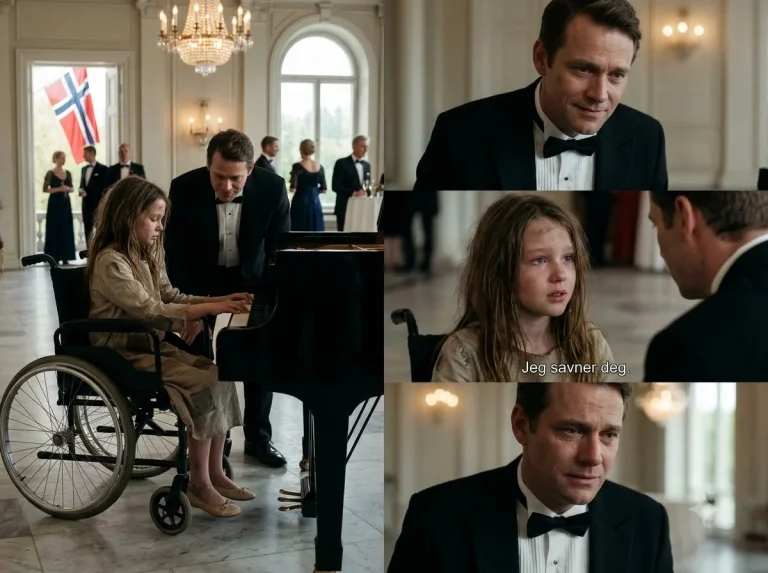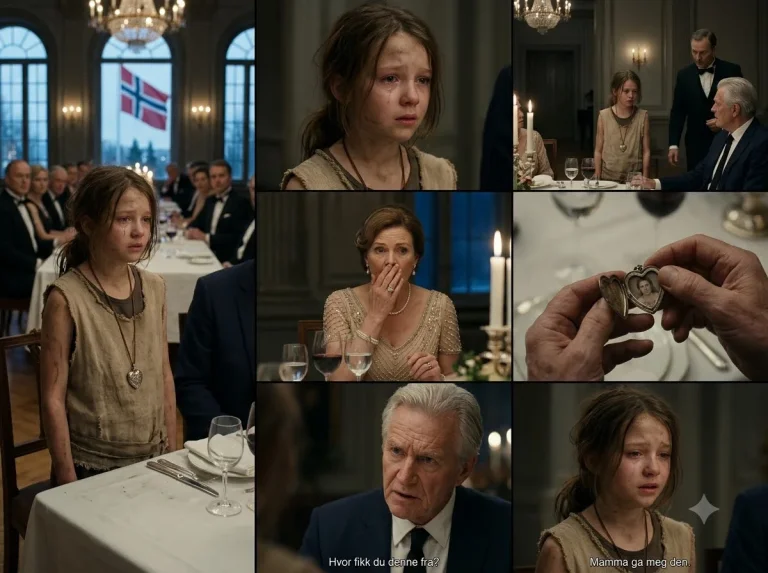
På julaften kjørte Elias Rowan gjennom steinportene til Whitmore-eiendommen for første gang siden skilsmissen og visste, før han i det hele tatt hadde gått ut av lastebilen, at det sannsynligvis hadde vært en feil å komme.
Den sirkulære innkjørselen så ut som ankomstveien utenfor en privat galla. Svarte SUV-er sto på tomgang under vinterbare trær innhyllet i hvite lys. En Bentley i mørk te-farge sto ved siden av to polerte luksussedaner. Tjenere i mørke frakker beveget seg mellom dem under gløden fra portikoen.
Så rullet Elis gamle grå pickup over brosteinene, fjæringen ga fra seg et velkjent stønn da han gled bak en rekke biler verdt mer enn verkstedet hans.
Tjeneren som nærmet seg kunne ikke ha vært eldre enn tjue.
“God kveld, sir.”
“God kveld.”
Den unge mannen kastet et blikk på lastebilen, så på Eli, men sa ingenting om noen av delene. Han pekte bare mot et åpent område nær servicesiden av huset.
Eli ga ham nøkkelen.
“Clutchen fester seg litt når det er kaldt.”
“Jeg skal huske det.”
Den lille utvekslingen skulle vise seg å bli en av de varmere velkomstene Eli fikk den kvelden.
Han hadde ikke planlagt å tilbringe julaften på Whitmore-eiendommen.
Tre dager tidligere hadde en konvolutt ankommet verkstedet hans.
Ikke en e-post. Ikke en melding videresendt gjennom Clare. Ikke en melding fra en assistent.
En konvolutt.
Kremkraft.
His name had been written by hand in black ink pressed firmly enough to leave an impression in the paper.
Elias Rowan.
The return address belonged to August Whitmore.
Eli had stood just inside the loading door of his furniture restoration shop with sawdust still on his sleeves and cold December air leaking around the frame.
For eleven years, the Whitmore family had communicated mostly through absence.
For three years since his divorce from Clare, that silence had been almost complete.
He had come to prefer it.
Inside the envelope was one line.
Christmas Eve. 7:00. Come alone. I need you there.
Eli read it twice.
Then he placed it on his workbench beside the walnut sideboard he had been stripping for a customer in the next county.
The shop smelled of mineral spirits, old glue and wood dust. A radio played softly near the office door. Outside, tires hissed along wet pavement behind the repair shop next door.
There had been a time when Eli would have looked at that rented industrial bay and seen proof that August Whitmore had been right about him.
Now he saw a business that paid its bills.
He saw two workbenches he had built himself, shelves of carefully labeled stains and finishes, a restored nineteenth-century secretary waiting for pickup, and a calendar with enough customer names on it to carry him through March.
It had taken years for those things to stop looking like consolation prizes.
His daughter was in her first year of college and called him most Sundays. His pickup had nearly a quarter-million miles on it. His shop had survived the period in which every month seemed to contain one invoice capable of ending it.
By the standards Eli had learned to trust, he was doing all right.
By Whitmore standards, he remained a cautionary tale.
A man who had once stood inside the gates and then somehow chosen a life outside them.
Two weeks before the invitation, August had called the shop.
The call had been strange from the beginning.
The old man asked about the rolltop desk he had sent Eli several years earlier.
The desk had belonged to August’s grandfather. Dark oak, brass fittings, one corner scarred, one drawer specifically left untouched because August had told Eli not to open it until he said otherwise.
“Still have it?” August had asked.
“Still have it.”
“Bottom drawer?”
“Still closed.”
A pause.
Then August had said, “There are some things I have been wrong about for far too long.”
Eli waited.
August did not explain.
The call ended less than six minutes later.
Now, standing beneath the Whitmore portico at ten minutes before seven, Eli wondered whether that sentence had pulled him across the county more effectively than any invitation could have.
Preston Carrington was on the front steps.
Of course he was.
Preston stood with three men beneath the Christmas lights, one hand around a short glass and the other tucked into the pocket of a beautifully cut navy coat.
He saw Eli’s truck before Eli reached the steps.
Eli knew he had seen it because Preston’s gaze stayed on the driveway half a second too long.
He waited until Eli was close enough to hear.
“The valet probably can’t decide whether to charge him for parking or towing.”
The men around Preston laughed.
Not loudly.
That quick, efficient laugh people gave when remaining useful to the person speaking mattered more than the joke.
Just inside the doorway, Clare turned.
She wore a deep green dress, simple and elegant, and for one confusing second Eli saw the woman he had first met years ago instead of the woman he had divorced.
Then her expression changed.
“Preston.”
It was not a command.
It was a warning worn smooth from repetition.
Preston lifted his glass slightly as though he had no idea what she meant.
Eli climbed the steps.
“Good evening.”
One of the men coughed into his fist.
Another suddenly found the front lawn interesting.
Preston smiled.
“Merry Christmas, Eli.”
“Merry Christmas.”
Eli walked inside.
The laughter followed him through the doorway like cold air.
Vivien Whitmore met him in the foyer beneath a chandelier large enough to require its own maintenance schedule.
At sixty-eight, she remained immaculate in a way that seemed less like vanity than discipline.
Her silver-blond hair was set perfectly. Her dark red dress showed no wrinkle. Her smile arrived at the correct social moment and stopped exactly where her eyes began.
“Elias.”
“Vivien.”
She took one of his hands briefly between both of hers.