The company whose exhibitions featured gemstones worth millions.
A company controlled, according to every public document I had ever seen, by the Moretti family.
And according to a tiny strip of film hidden inside my mother’s bracelet, more than half of it had once belonged to her.
My hands began shaking.
“Why didn’t she tell me?”
Gabriel turned over the next photograph.
“There’s something else.”
A row of dates.
A series of transfers.
And a handwritten notation beside an old trust account.
Beneficiary: Claire Evelyn Bellamy.
I stared at my name.
Then at the final notation.
Original ownership documents preserved in Echo Archive. Do not release through M.V.
My skin turned cold.
“M.V.,” I whispered.
Gabriel nodded.
“Those initials appear several times.”
I reached for my phone.
There was only one person I knew whose initials matched.
Miriam Voss.
My divorce attorney.
The woman who had protected me.
The woman who had arranged my disappearance.
The woman who had just warned me not to look into the past.
I looked at Gabriel.
“She knew.”
He didn’t answer immediately.
Then he said, “I think she knew long before your divorce.”
And somewhere in Chicago, someone who had spent years hiding the truth was about to discover that the one piece of evidence they believed destroyed had survived.
For almost an hour, I couldn’t move.
I sat at the kitchen table staring at my mother’s handwriting while Gabriel explained what the recovered film might mean.
Aurelia Atelier hadn’t begun as a Moretti luxury brand.
According to the document, it had begun as a partnership between Alessandro Moretti and a collective of independent Chicago jewelers led by my mother.
Alessandro supplied capital.
My mother supplied designs, workshops, artisans, and the manufacturing techniques that made the company famous.
The agreement assigned fifty-one percent of the original ownership to my mother through a trust.
Forty-nine percent belonged to Alessandro.
But years later, every public record identified the Moretti family as the sole owner.
“Someone transferred the shares,” Gabriel said.
“Without her permission?”
“That’s what we need to establish.”
I stared at the document.
“She never told me.”
“Maybe she was protecting you.”
I shook my head.
“From what?”
He looked at the name Moretti on the page.
Neither of us answered.
Then my phone vibrated.
An unfamiliar number.
A message appeared.
Withdraw from the competition. Forget the bracelet. Your son deserves to grow up.
For several seconds, I couldn’t understand the words.
Then an icy sensation spread across my chest.
I showed Gabriel.
He read the message once.
His face changed.
“We’re calling the police.”
I didn’t argue.
Within an hour, two detectives had come to the house.
They photographed the threatening message, reviewed the footage from our doorbell camera, and took a statement about the black sedan.
One of them, Detective Sarah Bennett, was a woman in her forties with sharp eyes and a remarkably calm manner.
She studied the legal documents.
“Do you believe the threats are connected to the ownership dispute?”
“Yes,” I whispered.
“Do you know who sent them?”
“No.”
She looked at the microfilm photographs.
Then asked something that made me feel foolish.
“Where is the original archive mentioned in the note?”
I stared at her.
“I don’t know.”
“Does Echo mean anything besides your mother’s old company?”
“Her workshop.”
“Does anything from that workshop still exist?”
I opened my mouth.
Then closed it.
My mother’s original workbench.
The heavy walnut table with brass fittings.
The one I had refused to sell after her death.
The one standing in my own studio.
I looked at Gabriel.
He was already reaching for his keys.
We didn’t go alone.
Detective Bennett arranged for an officer to accompany us while Gabriel and I opened the studio.
It was nearly midnight.
Rain washed over Oak Park, turning the sidewalks into ribbons of reflected streetlight.
My studio occupied the second floor of a converted brick building.
Normally, entering it made me feel peaceful.
Tonight, the familiar smell of polishing wax and warm metal filled me with unease.
My mother’s workbench stood beneath the eastern windows.
It was old, scarred, and beautiful.
I had spent thousands of hours sitting there.
Creating engagement rings.
Repairing heirlooms.
Making jewelry for women who saved money for months to buy something that belonged only to them.
I ran my fingertips over the walnut surface.
“Hello, Mom,” I whispered.
Gabriel examined the old brass plaque attached to the rear of the bench.
ECHO WORKSHOP.
Below the lettering was a tiny decorative star.
It looked remarkably similar to the clasp on my mother’s bracelet.
He carefully measured the star-shaped recess.
Then held the damaged clasp beside it.
The dimensions matched.
“Claire.”
I leaned closer.
“What?”
“I think this was designed to fit.”
With my permission, he inserted the undamaged underside of the clasp into the recess.
There was a soft click.
Nothing else happened.
Then he pressed the tiny brass star.
A narrow section beneath the workbench slid forward.
I gasped.
It was a concealed compartment.
Inside lay a metal document case wrapped in faded blue cloth.
For a moment, I couldn’t touch it.
My mother had been dead for seven years.
And yet here she was.
In the quiet of my workshop.
Waiting.
Detective Bennett photographed the compartment before allowing Gabriel to lift out the case.
Inside were original partnership contracts, correspondence, handwritten ledgers, and several carefully labeled recording devices.
There was also a sealed envelope.
On it, in my mother’s handwriting, were two words.
My Claire.
My knees weakened.
Gabriel pulled a chair beside me.
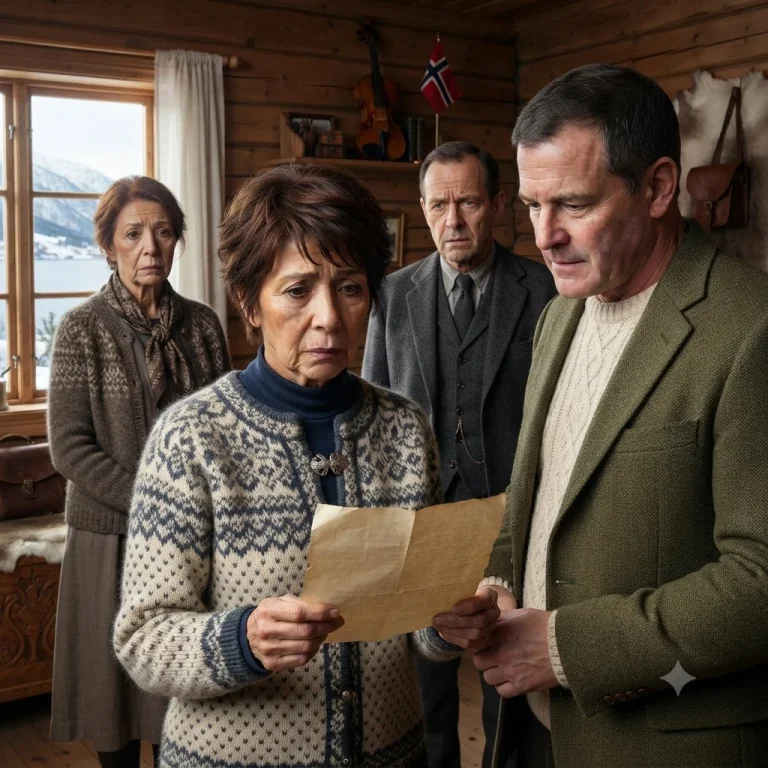
I opened the envelope with trembling fingers.
The letter inside was dated six weeks before my mother’s death.
My darling girl,
If you’re reading this, then someone has tried to take away more than a piece of jewelry.
I wish I had been brave enough to tell you everything while I was alive. I thought I could settle the matter myself. I thought I could protect you by keeping you outside it.