Ethan had learned to navigate rooms full of wealthy strangers.
Noah was quiet and analytical.
Ethan was socially confident but secretly insecure.
They argued about music, movies, mathematics, and whether pineapple belonged on pizza.
Yet somehow they understood each other.
Perhaps because both knew what it felt like to discover that the story of your childhood was incomplete.
After the presentation, the three of us went to dinner.
Ethan raised his glass.
“To Noah.”
Noah groaned.
“Please don’t make a speech.”
Ethan grinned.
“To the only person I know who can turn an eight-minute explanation into a forty-minute lecture and still claim he simplified it.”
I laughed.
Noah threw a napkin at him.
Ethan continued.
“Seriously, though. I’m proud of you.”
Noah’s expression softened.
“Thanks.”
They clinked glasses.
Then Ethan looked at me.
“Ms. Bennett?”
“Yes?”
“Can I ask you something?”
“Of course.”
He hesitated.
“Would it be strange if I called you Claire?”
I smiled.
“Not at all.”
He looked relieved.
Then his expression became more serious.
“There’s something I’ve wanted to tell you.”
I waited.
“After everything came out, I thought you’d hate me.”
I shook my head.
“Ethan—”
He raised a hand gently.
“Please let me finish.”
I nodded.
He looked down.
“I spent years thinking that being Vincent Moretti’s son was the most important thing about me.”
He paused.
“Then I found out I wasn’t his biological son, and I thought I’d lost everything.”
Noah watched him quietly.
Ethan continued.
“But you and Noah helped me understand that family isn’t always something you’re born into.”
My eyes filled.
He smiled.
“Sometimes it’s something people choose.”
I reached across the table.
“Yes,” I whispered.
He squeezed my hand.
Then he said something that made me cry.
“Thank you for never making me pay for what my mother did.”
I stood and hugged him.
He held me tightly.
And in that moment, I realized that the boy I had once imagined as the symbol of my humiliation had become someone I loved.
Not as a replacement for Noah.
Not out of obligation.
Simply because Ethan himself was worthy of love.
I thought the story was finally ending.
Sophia’s legal troubles had largely reached their resolution.
Adrian Voss’s remaining proceedings were still moving through the courts.
The financial recovery process continued, but the most important facts had been established.
Noah was thriving.
Ethan was rebuilding his life.
Vincent was learning, painfully and slowly, how to be a better father.
And I had finally made peace with my past.
Then, one evening in December, Noah came home carrying a small wooden box.
It was old.
Dark mahogany.
Its brass hinges were tarnished.
I recognized it immediately.
My father’s jewelry box.
The one I had kept in storage since moving to Boston.
I stared at him.
“Where did you find that?”
He set it on the kitchen table.
“In the attic.”
I smiled.
“I haven’t opened it in years.”
Noah looked strangely nervous.
“Mom, there’s something inside.”
I frowned.
“What?”
He opened the lid.
Inside lay my father’s pocket watch.
The same watch I had carried away from the Moretti mansion eighteen years earlier.
I touched it gently.
My father had worn it every day.
After his death, it had become one of the few objects that made me feel close to him.
But Noah wasn’t looking at the watch.
He was looking at a folded piece of paper beneath it.
“Did you know this was here?”
I shook my head.
“No.”
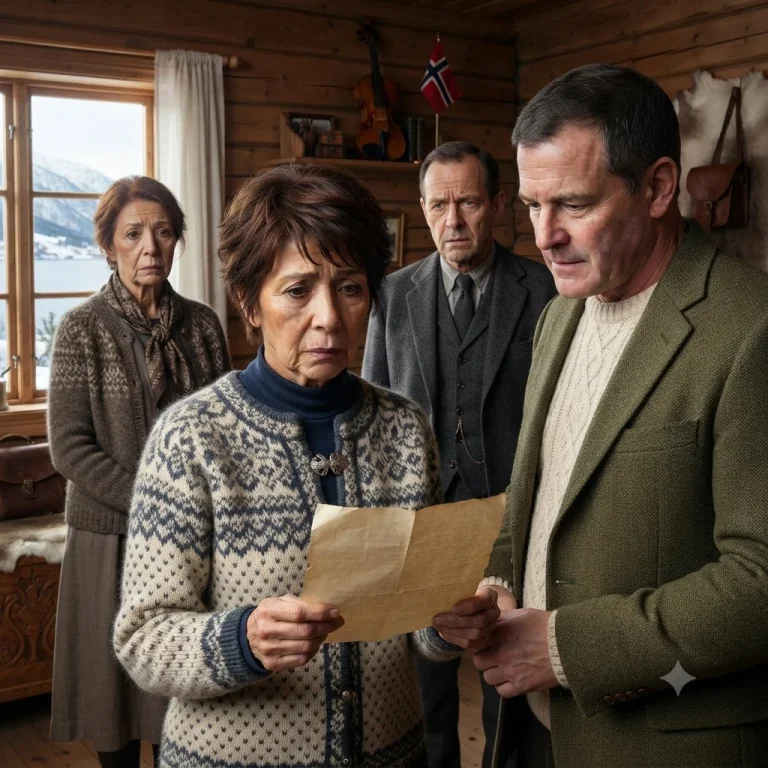
He handed it to me.
The paper was yellowed.
My father’s handwriting filled one side.
My heart tightened.
I unfolded it carefully.
At the top was a date.
A date from twenty-three years earlier.
The year I married Vincent.
And beneath it were words I had never seen before.
“My dearest Claire, if you are reading this, there is something about Vincent Moretti’s family that I never found the courage to tell you.”
I stopped breathing.
Noah leaned closer.
“Mom?”
I stared at the letter.
Then began reading.
My father had worked as a financial investigator before retiring.
I knew that.
What I hadn’t known was that one of his final investigations had involved the Moretti family.
More specifically, Adrian Voss.
Years before my marriage, my father had uncovered suspicious transactions involving Voss and several private accounts.
He had attempted to report them.
But his concerns had been dismissed.
According to the letter, Voss had threatened his career.
Then, after my father became ill, he had stopped pursuing the matter.
But he had never forgotten.
The final paragraph made my hands shake.
“Vincent may be a good man, Claire, but I do not trust the people around him. If anyone ever asks you to sign documents you do not understand, refuse. If your marriage becomes troubled, protect your own name. And above all, never allow Adrian Voss to control anything that belongs to you.”
I lowered the letter.
Noah was silent.
I stared at my father’s handwriting.
For years, I had thought his pocket watch was simply a reminder of love.
Now it had delivered a warning across more than two decades.
I felt tears fill my eyes.
“Dad,” I whispered.
Noah touched my shoulder.
“Are you okay?”
I nodded slowly.
But I wasn’t.
Not entirely.
Because the letter raised a question I could not ignore.
Had my father suspected the people who would eventually destroy my marriage?
And if he had, why had he never told me while he was alive?
I read the letter again.
Then noticed something on the reverse side.
A name.
A date.
And a single sentence.
“The original records are with Eleanor.”
I stared.
Eleanor.
My mother’s name.
My mother had died when I was nineteen.
My father had followed several years later.
There was no one left to ask.
Or so I thought.
Then Noah spoke.
“Mom, who’s Eleanor?”